




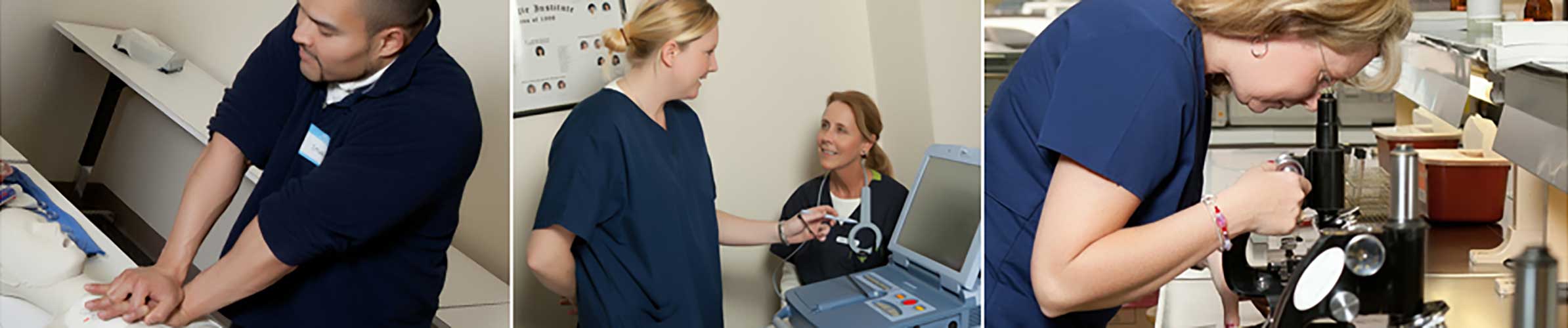
AOS Invasive Cardiovascular Technologist Program
Go with the leader in allied health training since 1947 at the Carnegie Institute in Michigan.
AOS Catalog Addendum For Invasive Cardiovascular Technologist Program (Click Here)
Our online and practical application classes (hybrid training) provide thorough, comprehensive education and working knowledge of required skills and competencies. Develop confidence in small class sizes, one-on-one instruction, and competent, experienced faculty. Find out why medical employers depend on Carnegie graduates.
The AOS Invasive Cardiovascular Technologist student is trained to assist the physician in performing invasive testing techniques, which provide critical data for detecting and managing cardiac and vascular diseases. Students develop skills in preparing and monitoring patients during invasive cardiac procedures and other treatment modalities.
AOS Invasive Cardiovascular Studies include:
- GE011 Anatomy & Physiology
- GE130 Written and Oral Communication
- GE112 Algebra1
- Anatomy & Physiology/Pathophysiology
- Therapeutic Communications
- Cardiovascular Pharmacology
- Basic & Advanced Electrocardiography (EKG)
- Physics
- Vital signs
- Sterile Technique
- Patient Assessment
- IV Administration
- Diagnostic Cardiac Catheterization
- Hemodynamics
- Radiation Safety
- Recognition of and intervention in lethal arrhythmias
- Interventional Procedures such as angioplasty, stents, and intra-aortic balloon pumps
- Peripheral Intervention
- Cardiac Pathology
Emerging technologies in peripheral vascular intervention, as well as concepts in cardiac electrophysiology and pacemakers, are explored to prepare students for expanding career opportunities. Advanced Cardiac Life Support (ACLS) is presented in accordance with the guidelines of the American Heart Association.
Advanced Cardiac Life Support (ACLS) is presented in accordance with the guidelines of the American Heart Association.
Is a Career as an Invasive Cardiovascular Technologist Right For You?
Take the Free Healthcare Career Training Readiness Quiz!

In only 3 minutes, receive a personalized report identifying your strengths and social style. Learn what training & careers are best for you!
The Clinical & Externship Experience
The clinical/externship rotation is an integral part of the training program. Eligible students are assigned to a school-approved clinical site by the Program Director. Students will maintain this rotation until all required hours have been completed within the allotted time frame. Site visits to hospitals are conducted regularly by the school clinical site coordinator to assess the student’s satisfactory progress.
Due to the technical nature of this program, students must have prior training in allied health, recent clinical work experience, and college credits in anatomy & physiology, as well as math and science.
Career Placement
The knowledge and skills acquired prepare students for responsible career entry positions with advancement opportunities in hospital cardiac catheterization laboratories. A widespread, critical demand exists for competent, credentialed Invasive Cardiovascular Technologists.
Medical Employers depend on Carnegie Invasive Cardiovascular graduates. You can trust the Carnegie Institute, with over 79 years of providing quality education, training, and career placement for students like you.
Other Programs Carnegie Institute Offers
- Cardiac Electrophysiology Technologist
- Cardiology Technician
- Cardiovascular Technologist
- Electroneurodiagnostic Technologist
- Invasive Cardiovascular Technologist
- Massage Therapy
- Medical Assistant (Full-Time and Part-Time)
- Medical Insurance Biller
- Vascular Technologist
Publication of Outcome Results
According to the Commission on Accreditation of Allied Health Education Programs (CAAHEP) and the Joint Review Committee on Education in Cardiovascular Technology (JRC-CVT) Standards, schools must publish outcome results for the following programs: Invasive Cardiovascular Technologist, Vascular Technologist, and Cardiovascular Technologist, based on the 2020 Annual Reports Management System.
The published results are consistent with our 2025 JRC-CVT Annual Report. These results represent a three-year average for the Invasive Cardiovascular Technologist (ICVT) Program’s outcomes, including national credentialing pass rates, retention, and positive placement, for the years 2024, 2023, and 2022.
Average Rate of Graduates who took and successfully passed the RCIS national credentialing through CCI: 100%.
Average Retention Rate: 91.67%.
Average Positive Placement Rate: 100%.
Textbooks & Reference Manuals
| Publisher | Title | Author | ISBN | Price |
|---|---|---|---|---|
| Lippincott | ECG Workout Book | Huff | 978-1-4511-1553-6 | $75.00 |
| APRN World | Cardiac Pharmacology, 2nd Edition | Nair | 978-194-100-4128 | $60.00 |
| Elsevier | Anatomy & Physiology, 9th Edition | Patton/Thibodeau | 978-0-3232-9883-4 | $205.00 |
| Elsevier | Netters Cardiology | Runge | 978-1-4377-0637-6 | $100.00 |
| Jones & Bartlett | Invasive Cardiology | Watson | 978-0-7637-6468-5 | $117,00 |
| AHA | ACLS | Woodson Education | $250.00 |